Monday, 16 July 2012

The Quagmire of the PhD

When I started this blog, I wrote that it was a tool for me to be reflective about my journey through my PhD, but also to offer an 'insider's guide', if you will, to all aspects of being a PhD student.  I regret to say that today's post highlights some of the more turbulent experiences of - what I hope is - a typical PhD student nearing the end of their first year.

As I'm sure most PhD students experienced, I began my PhD with bountiful enthusiasm.  I could cope with hours upon hours of reading because I was interested.  I wrote lots of notes, I colour coded lots of things, I organised my office and labelled folders and collected journal articles like they were going out of fashion.  I approached potential studies like an over-excited puppy, reading everything, writing ethics forms, and all the while thinking how great it was to be learning.

I miss old me.

New me hates everything.  I should add a little caveat here, in that I still wouldn't want to be doing anything else.  But that doesn't mean I don't hate it.  I hate the never-ending "How's the PhD going?", or "Have you finished your literature review yet?".  Worse still are the "You really need to get working on that you know", the "You better not be thinking of quitting" or the "Why aren't you published yet?"

The rational part of me knows people not asking these questions or making these statements from a negative standpoint.  They are are asking (a) because they care or (b) because they think it is a safe topic, much like "How is work?", except it's not like that at all.

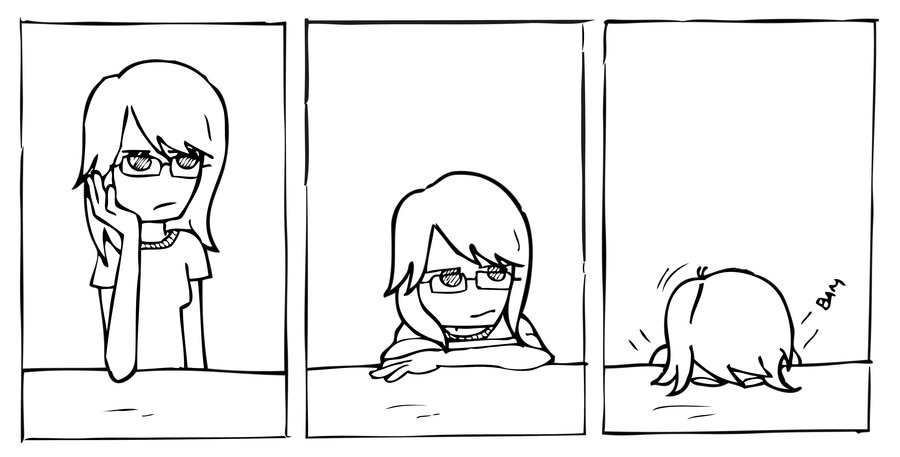
Every day, I struggle to get in front of the computer.  If I do, I invariably stare for hours at a blank document or reread what I've already written without making any new progress.  I despise the topic, the literature and my own poor writing.  Avoidance, although temporarily relieving, perpetuates the guilt cycle.  

I don't work - I feel guilty - I try to work - I fail miserably - I hate everything - I don't work.  I think we can agree, it's not the most productive of cycles.

Funnily enough, I was warned by everyone who had been doing their PhD for more than 12 months to expect this.  All have good advice - advice I've returned on the odd occasion - and while I know how good it is, I just can't seem to follow it.  I took a few days away from it all, in the hopes I'd break the cycle, but as we're currently refitting our kitchen in our tiny one-bedroom flat, it wasn't really days off to relax.  It was days off to work 8-16 hours on a kitchen I am also rapidly growing to hate.  (That's a rant for a whole other day though).  I came into the office today to get out of that environment, but here I sit writing this post, rather than my literature review, the deadline for which is approaching at break-neck, terrifying speed.

I imagine this is what it must feel like for the proverbial deer in the headlights.  I see my deadline racing towards me, flashing warning signs all through my diary and calender that the end is near, but I am paralysed by fear and inability to do anything so it sits, with 4250 words completed (many of which will need rewritten) and I am writing blog posts.

Those of you who have been here I'm sure can commiserate.  For those of you who haven't yet, I hope I am not diluting your enthusiasm.  But these are the realities of the PhD, I suppose.  I hope that soon I might be able to write about overcoming this, but for now, I am all Bambi-like and unable to write anything related to my topic.  Or even talk about it.  

Just don't ask me how my PhD's going.

Monday, 18 June 2012

Literature Review III: Choppy Writing


I'm considering myself well into the writing mode now and am close to halfway towards my word limit (which has been revised to 8,000-9,000 at most now).  As I've said before, this is my first real piece of academic writing since my undergraduate days, and I've noticed that I've approached this project in a completely different way.

One of the main obstacles for me has been the lack of a solid question. Obviously, I have a question I am trying to answer within the review, but I'm talking about the smaller sort of sub-questions that shape the direction and style of your argument.  For example, when I am writing about magic, I want to establish the value of magic research in science, as well as discussing the work that has informed my own research.  The former is quite a broad topic, where the latter is much more specific, yet these are to be covered within one large section about magic. 

If we continue with this example, my problem has been how to make the progression between each subsection within the magic area.  This has resulted in what I've called "Choppy Writing".  I go from one section to another, writing a few sentences or paragraphs as I come across something I think will link into that section, or as I read a paper and see that what I've written might be better placed elsewhere, and so on.

I don't suppose this in itself is inherently problematic (although I can see me having to do crazy proof-reading to make sure I've still got all the references that are in my reference list) but it does feel strange for me to write in this way.  I've mentioned before I like to write a section in its entirety before I move on, or at least - I used to.  This time, the choppy writing has come to me naturally; it seemed the most intuitive way to approach the topic.  Write what I could when I could, so that something is down on paper.  I suppose that's what drafts are for - editing is where I need to shape it up and refine the ideas and arguments.

The draft itself still feels very rough and I'm not sure how good anything I'm producing is, but at least I'm at the point now where I am going to send one completed subsection to my supervisor.  The prospect terrifies me, but I think it is okay, so I need to see where my judgements of the work stand in relation to my supervisor's.  We shall soon see!

Monday, 4 June 2012

Lit. Review Part 2: Once more unto the breach

It's been two weeks that I've been "writing" my literature review.  Two weeks, and I have produced 1,590 words.  

In reality, I've probably written closer to 6,500 words, but I've deleted them all.  I rewrote and rewrote and rewrote and ended up having written nothing.

Herein lies my first big mistake.  Stop rewriting!

If you consult a 'how-to' book about writing novels, it will tell you to get that first draft down on paper regardless of crappy spelling, poorly developed plot-lines and weak characterisation.  I have read one or two of these books in my time, but didn't think to apply it to my literature review.  So instead, I got hung up on each sentence.

.
You can understand why - it's an important piece of work.  Important people read it.  If I hand in something... less than excellent it makes me feel I am damaging my future reputation and credentials as an academic.  But, please, learn from my lesson.  This approach leads to writing less than 1,000 words a week.  Bad Katy.

The second thing I have learned so far is that you don't always have to start at the beginning and end at the end.  My literature review has two (possibly three) main sections.  I started with the first section because it was first.  It was also the hardest and the one that might get incorporated into the other sections.  Now, it took me ten whole days to realise: this was a dumb idea.  All through my undergraduate, we wrote experimental reports.  I always wrote the methods and results first, then discussion and lastly introduction and abstract.  Obviously, that's not it order.  I can't tell you how much of an idiot I felt when I realised I should apply the same principles to writing a literature review.

Duh.

So, in the last three days or so, I've been writing the section about magic, which has been good for two reasons.  First of all, it means I'm actually writing something.  This is an area I know better and am more enthusiastic about so the words come more easily.  That has a knock-on secondary effect - I don't feel like such an idiot.  I probably don't need to elaborate on why that's a good thing!

I feel like I haven't progressed much yet.  It's like Literature Review and I are in a state of war.  We occassionally give each other peace for sleep and so on, but even that's disrupted by random thoughts and dreams that I'm writing.  Daily activities bombed by guilt "You should be writing!" and tired-brain "Stop making me do this!  I give up!  I surrender!"  However, I am regrouping and reinforcing my defenses.  I wade once more unto the breach.  And hopefully, next time, I can tell you "We are in the final stages of war.  We shall be victorious!"

Monday, 21 May 2012

The Literature Review - Part One

As with many universities, at my School, your first year as a PhD student is sort of like probation.  You get a chance to learn the ropes (or to try, anyway), to start figuring out what your question is and to generally feel overwhelmed by what you've signed up for.  

However, as probation starts to draw to a close, you remember that little paragraph somewhere in the postgraduate student handbook you read months ago, that you have to submit a piece of work to be judged as an assessment on whether you should become a fully-fledged, official PhD student.


Uh oh.  Frantically, you race back to the handbook, scroll through endless amounts of information to reach that paragraph and confirm - it says you've got a lot of work to do!  

That's the point I'm at.  I have my first proper piece of work to do (MSc module assignments aside).  For the 27th of July, I must write an 8000-10,000 word literature review on my topic.  Gulp!  For those of you further on in your PhDs, you are probably reading this and shaking your head with the memories of your first "big" piece of work and thinking to yourselves 'Oh just wait for what's to come.'  I realise that I'm probably going to cross this threshold soon and that in 6-9 months, writing a lit. review will seem like nothing.

Right now, though, it seems huge.  Which is why I thought it'd be helpful to write a short series of posts as I go through the process to illuminate it for anyone (a) thinking about doing a PhD so you can be forewarned, or (b) also going through this so you can commiserate too.

Now, I didn't do a Masters, so my last piece of academic writing was my undergraduate dissertation in my fourth year.  It was 7,500 words, so not too uncomparable in length, but the difference was it didn't really matter what you said.  Of course, you had to make sense, present your argument in a logical way, etc., but it didn't matter if your experiment was unsuccessful or if you hadn't fully grasped all the relevant concepts.  I think we all know that your literature review for your thesis, on the other hand, is a very different story.

So take my nervousness about writing academically, my awareness of how important it is - which leads to a sense of terror - and add in the fact that I have no idea how to write a literature review.  The latter, I feel, is likely to be my biggest hurdle.  I mean, I'd heard the term before, but what is a literature review when you get down to it?

At the moment, my understanding is that it is a way for you to present an argument for your research topic and demonstrate its grounding in relavent literature.  Ok, great.  I have an OED definition.  But how the hell do I go about writing one? 

My current plan is planning.  I've got a basic plan of progression (subheadings with bullet points illustrating what I might talk about), so I can begin to form an idea of how to tell the story, as it were.  I'm actually meeting with my supervisor today to discuss it, so I can either be given the go ahead, or be told to have another think about it.  It's daunting to consider 10,000 words at once, so instead, I'm trying to think of each individual section as a mini essay.  I have three subheadings to work with, each with their own subtitles, so I have the bare-bones framework for a very rough first draft.

The second hurdle is the fear.  I am finding it hard to persuade my fingers to commit anything to paper.  In fact, that's part of my reason for writing this - I figure the more I encourage myself to write, the more my brain will be in a "writing" mode.  My concerns about this are almost evenly divided into the rational and irrational.  I'm concerned it wont be good enough, and I wont be allowed to progress in my PhD.  This is a rational fear, I feel, as it would rather affect my life plan.  But other fears, like "I can't write anything!" I know are unfounded.  I have, after all, just written a rather long blog post about the whole topic.  

I don't imagine this being an easy task, but I hope that by taking semi-regular breaks to tell you all about it will help me take an objective perspective on it all once in a while.  This will hopefully help me retain my sanity, and remember that, in the grand scheme of things, there's only another 90,000-92,000 words to go.  

Eek.

Monday, 7 May 2012

The First Big Blow


In the last week, I've had the first big blow to my PhD confidence.  My first study, which has been my focus up until now, was finally at the analysis stage.  The pilot had been run, the follow up concluded and hours upon hours upon hours of coding finally finished.  It was time for analysis.

It turns out, I have nothing.  No results.  Nothing I can use.  It's not just an absence of what we thought would happen.  Every single participant did a different thing, which means I can't even say "Well they didn't do x, but they did y!"  I can do nothing with it.  I'm not going to lie.  This was one of the toughest things I've ever had to overcome.  With real-world vision research, you can't just run another few participants.  Coding takes so long per person that it's unfeasable if the pilot shows no pattern.

Obviously, this is hard because it is my first study and it has gone wrong.  But it's also hard because it is a reinforcement of fears like 'I'm too far behind everyone else', 'I'm never going to complete on time' and 'Am I really good enough to be doing a PhD?'  I'm sure these are fears everyone faces and I know failure is not individual to me or my research.  I knew this was something I needed to anticipate, I just didn't expect it so soon.

It's also difficult because in my School, we have to complete a piece of work in our first year that is our assessment to be allowed to continue.  My work had been going to be a write up of this study, so I'd been working on it for a while already.  However, now I will need to do a literature review instead.  This is scary, because I would've been preparing a long time ago if I knew that, and I am not confident about my writing.

However, I'm trying to see the bright side in all this.  After several days of allowing myself to mope that is.  At least this has happened now, rather than my second or third year when I'd be even more stressed.  And at least it was not a huge study.  It's going to give me practice at writing. 

I'm not quite believing these positives yet, but I'm working on it.  It's all still a bit raw.  But hey - if I can get through this, I guess I can get through anything.

Friday, 20 April 2012

Thinking Evolution


First of all, apologies for the long delay in my return to blogging. As I said in my last post, there have been a lot of family things going on. Things have improved a lot since then and I have returned to life 'as normal' as a PhD student.

Over the last few weeks, postgraduate seminars held at the School have had a much more job-oriented focus. We've heard about a few of the post-docs' job seeking experiences and learned how to write academic CVs and cover letters. These sorts of things are obviously invaluable to know about if you want a career in academia - as I do - but I've noticed that alongside these events, I've had some real shifts in my thinking.

Up until recently, I'd almost been embarrassed to tell people I was a PhD student. I felt they'd think I was boasting and to be honest felt like since I didn't really know what I was doing, I couldn't really call myself that. But yet, talking to undergraduates over the last month about my experiences and starting to think about the future as an academic seems to have evolved how I think about myself as a PhD student.

Instead of the "I'm new and don't know what I'm doing!" sort of feeling, I've begun to settle into the everday life of a PhD student. I am less worried about days where I don't get so much done, because in my head I can feel an understanding of my topic developing. I find myself plotting out the 'story' of my current experiment with the literature that I know, identifying gaps and almost writing myself little memos in my head as reminders to look for specific papers or findings. And this tends to happen while I'm walking to uni, at the gym or when I'm just relaxing at home. (Of course, sod's law dictates this should never happen while I'm in my office).

I'm not saying I think everything's grand these days. I still worry about whether I'm keeping up, about how well my research is going and always "I need to be doing more". But, there is a big difference in thinking about things in this new way. I feel a bit more centred and a bit more in control too. That end goal is still a long way off, but I'm able to think about it now and plan what I want to do between now and then.

I'm also sure that this wont be the last change in attitude I experience before I finish my PhD, but this one at least means I feel a little more at home when I'm steeped in 'work'. Have your attitudes about yourself and/or your PhD changed over the time of your study? What gave you that I-can-do-this feeling?

Monday, 12 March 2012

Why it's important to be honest

When people are under stress, I tend to find there are two ways of dealing with it. Some people tell everyone, in some way venting the stress proportionately to the number of people they tell, and others internalise.

We all deal with stress as PhD students - it's part of the deal, really. Sometimes, though, stress comes along which we have no control over.

In the last couple of weeks, there's been a bit of a crisis in my boyfriend's family. I hasten to add we're both fine, but it's a stressful situation.

Previously, I've always been the sort of person to internalise when things were going wrong, but this time I faced a unique situation. There wasn't actually anything wrong with me, but my boyfriend was under a huge amount of stress and really needed my support. It seemed like a tricky situation to manage - how could I give him the support he needed without falling behind or to be seen as slacking?

Thankfully, I have an understanding supervisor. I spoke to him honestly about the issue - including the fact that it wasn't really me involved, but that I wanted to be there to support my partner. We agreed that I could work at home whenever necessary, pop into uni if I wanted or mainly catch up via email while the situation is still urgent.

That meant that I was able to take care of all the "home stuff" as I like to call it - cooking, cleaning, driving, last minute arrangements and so on, that you're not always in the right frame of mind for after a full day in the office. I was - and am - available to give bf the support he needs, without it impacting on my work. In fact, I've made more of an effort to be productive seeing as I'm not in the office.

I'd like to add too that his university have been incredibly understanding. Staff have been tactfully and discretely notified by the tutor he spoke to, and preparations are in place should he need an extension or exemption for coursework.

All this support from our universities has meant that bf has been able to be there for his family, and I've been able to be there for him, without the added pressure, stress and worry about uni work. I wanted to share, because unfortunately it's something you might face one day and I can't say it enough - be honest with your supervisors and/or tutors, because they can't help if they don't know what's happening. Their support has been invaluable to both of us, and it's meant that while things have of course been difficult, they haven't been nearly as bad as they could have been.

And if you TL:DR'd - If you have a problem, let your university know as soon as the situation occurs, and they will bend over backwards to help you. They want to see you do well, and will help however they can.